← Back to open source 9 articles · ≈ 27 minutes
i-have-adhd: readable responses, adapters and evidence · Open-source series Browse all 9 articles in this open-source series. Nine source-backed lessons on output structure, reversible installation, host lifecycles and honest evaluation, with fourteen isolated adapter cases.
Featured starting point
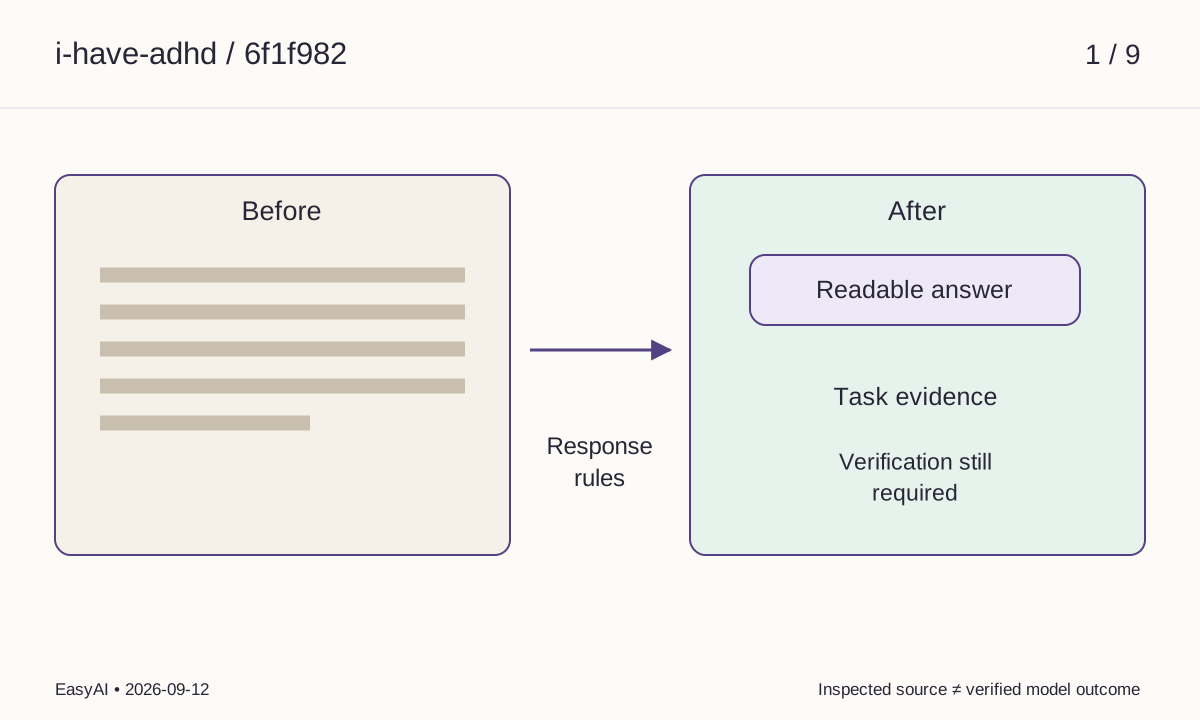
Learn what this output-style skill changes, how its adapters deliver instructions, and where readability claims stop short of evidence.
i-have-adhd explained: response structure, not a smarter model i-have-adhd ayghri/i-have-adhd
Start reading → Suggested learning path
01 → 09
01 2026-09-12 · 3 min read · Search intent: Learning
Learn what this output-style skill changes, how its adapters deliver instructions, and where readability claims stop short of evidence.
i-have-adhd explained: response structure, not a smarter model i-have-adhd ayghri/i-have-adhd
→ 02 2026-09-12 · 3 min read · Search intent: Learning
Use a small learning task to check activation, explanation quality and exit behavior before considering always-on configuration.
Try i-have-adhd in one reversible session i-have-adhd ayghri/i-have-adhd
→ 03 2026-09-12 · 3 min read · Search intent: Learning
Distinguish a Markdown skill from executable adapters, pin the reviewed revision and plan a narrow rollback before global installation.
Install and distribute i-have-adhd without confusing host configuration i-have-adhd ayghri/i-have-adhd
→ 04 2026-09-12 · 3 min read · Search intent: Learning
Trace startup injection, per-turn transformation and Pi session state without flattening them into a generic plugin diagram.
One ruleset, three persistence models in i-have-adhd i-have-adhd ayghri/i-have-adhd
→ 05 2026-09-12 · 3 min read · Search intent: Learning
Follow actual source branches and fourteen offline cases, including an empty rules file and preservation of an existing OpenCode command.
Read the i-have-adhd hook: markers, frontmatter and silent failures i-have-adhd ayghri/i-have-adhd
→ 06 2026-09-12 · 3 min read · Search intent: Learning
Account for injected context, output, retries and judging, and interpret the upstream failed release gate without cherry-picking improvements.
Measure i-have-adhd without confusing shorter answers with lower cost i-have-adhd ayghri/i-have-adhd
→ 07 2026-09-12 · 3 min read · Search intent: Learning
Review executable hooks, configuration boundaries and unsupported certainty before turning a response style into a persistent team default.
Operate i-have-adhd with explicit opt-in and a tested exit path i-have-adhd ayghri/i-have-adhd
→ 08 2026-09-12 · 3 min read · Search intent: Learning
Compare response-style delivery options by persistence, review surface and rollback rather than unmeasured product rankings.
Prompt, skill or always-on plugin: choose the smallest useful integration i-have-adhd ayghri/i-have-adhd
→ 09 2026-09-12 · 3 min read · Search intent: Learning
Design a small, auditable project with clean conditions, blinded review and blocker-first decisions; distinguish the proposal from a shipped tool.
Build a response-readability evaluation that can disagree with your expectations i-have-adhd ayghri/i-have-adhd
→