Featured starting point
NoSignups explained: a directory is not the same as a private tool suite
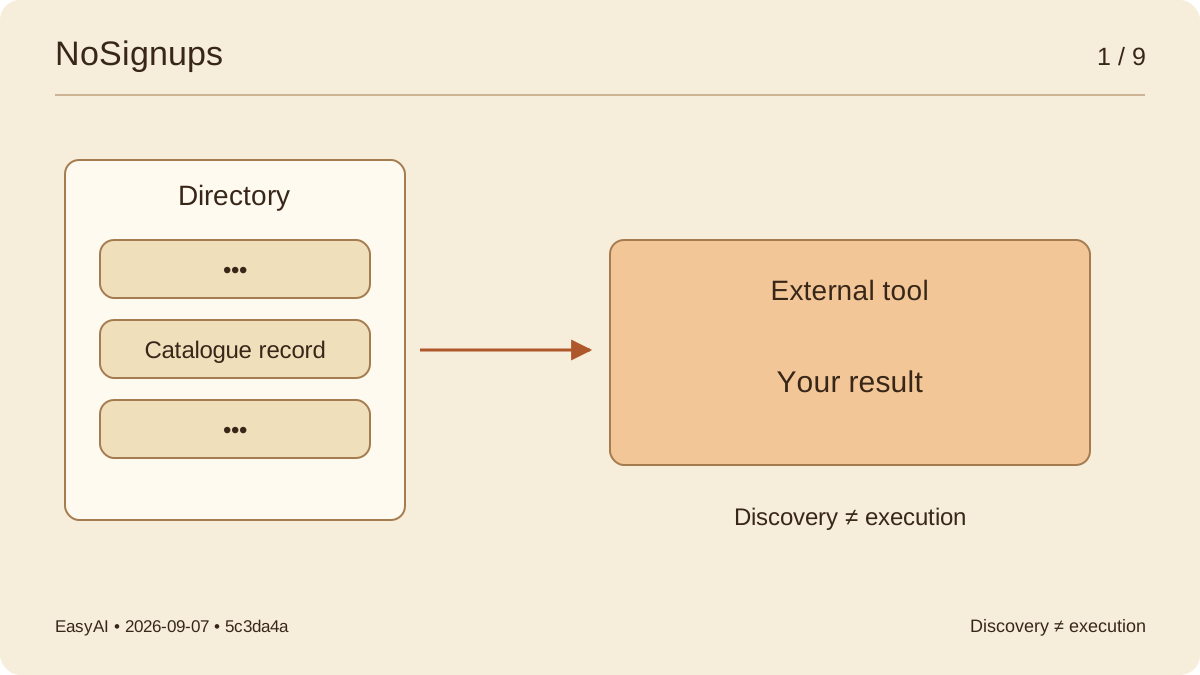
Meet NoSignups, formerly FckSignups, and separate its curated discovery experience from the behavior of the external tools it links to.
Browse all 9 articles in this open-source series. Nine guides to NoSignups (formerly FckSignups): discovery boundaries, Vite deployment, search internals, data validation and a review ledger.
Featured starting point
Meet NoSignups, formerly FckSignups, and separate its curated discovery experience from the behavior of the external tools it links to.
Suggested learning path
01 → 09
Meet NoSignups, formerly FckSignups, and separate its curated discovery experience from the behavior of the external tools it links to.
Use the documented Vite workflow, inspect the real Tool type and test category, search and editorial grouping with one harmless catalogue entry.
Understand what the Vite build deploys, why the production catalogue can change independently, and when the optional submission Worker becomes a separate service.
Trace the client-side data path and understand what fallback status, all-keyword matching and editorial sections mean for the displayed catalogue.
Read tokenize and matchScore with concrete edge cases, then distinguish runtime JSON validation from TypeScript types and README promises.
Separate network loading, local matching, rendering and maintenance effort, and build a measurement plan without inventing speed or cost figures.
Review outbound tool links, runtime catalogue validation and the GitHub-writing Worker without mistaking CORS or no-signup branding for authorization.
Compare discovery and execution workflows using the same harmless task, rather than treating a directory, search engine and owned utility as equivalent products.
Design a versioned catalogue review queue with reproducible search fixtures, explicit approval and useful static visuals before considering 3D decoration.