← Back to open source 9 articles · ≈ 27 minutes
Worktrunk: parallel worktrees, lifecycle control and source analysis · Open-source series Browse all 9 articles in this open-source series. Nine practical lessons on Git worktree coordination for AI development, with pinned sources, seven teaching-model cases and explicit runtime limits.
Featured starting point
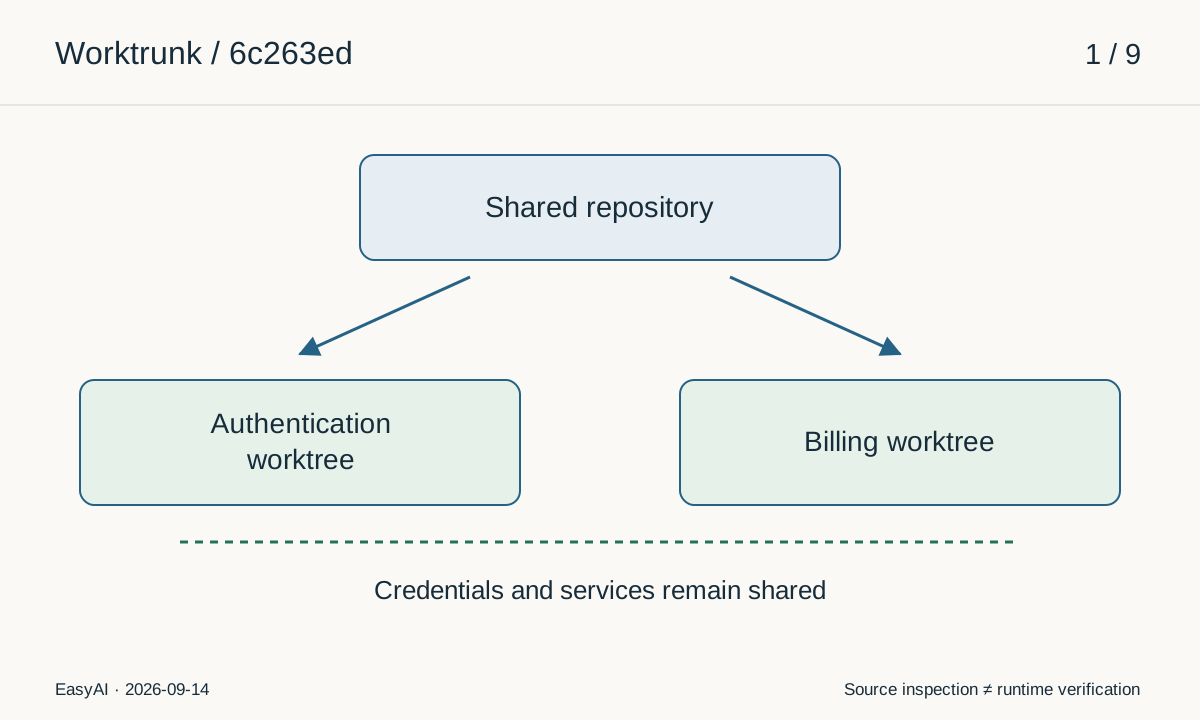
Understand how Worktrunk coordinates branches, directories and lifecycle commands, and why a separate worktree is not an agent sandbox.
What is Worktrunk? Git worktrees for parallel AI coding Worktrunk max-sixty/worktrunk
Start reading → Suggested learning path
01 → 09
01 2026-09-14 · 3 min read · Search intent: Learning
Understand how Worktrunk coordinates branches, directories and lifecycle commands, and why a separate worktree is not an agent sandbox.
What is Worktrunk? Git worktrees for parallel AI coding Worktrunk max-sixty/worktrunk
→ 02 2026-09-14 · 3 min read · Search intent: Learning
Learn the smallest worktree exercise, separate successful creation from shell navigation, and avoid accidental hooks or cleanup.
Worktrunk quickstart: one disposable branch and a verifiable result Worktrunk max-sixty/worktrunk
→ 03 2026-09-14 · 3 min read · Search intent: Learning
Separate package installation from shell integration and repository hooks, with a versioned rollout and a narrow rollback plan.
Install Worktrunk across macOS, Linux and Windows: binary, shell and configuration Worktrunk max-sixty/worktrunk
→ 04 2026-09-14 · 3 min read · Search intent: Learning
Trace control from an operation through configured commands, approval and pre/post hooks, including startup dependencies and merge behavior.
Worktrunk architecture: configuration, approvals and hook ordering Worktrunk max-sixty/worktrunk
→ 05 2026-09-14 · 3 min read · Search intent: Learning
Walk through approve_command_batch and approval storage to understand why accepting a command is different from remembering that acceptance.
Read Worktrunk approval code: --yes, persistence and failed saves Worktrunk max-sixty/worktrunk
→ 06 2026-09-14 · 3 min read · Search intent: Learning
Build a practical ledger for checkout preparation, builds, model calls and review time before deciding whether more agents improve throughput.
Worktrunk performance and cost: measure parallelism without inventing savings Worktrunk max-sixty/worktrunk
→ 07 2026-09-14 · 3 min read · Search intent: Learning
Review actual command authority, optional model data flow and recovery limits before automating merge or cleanup.
Operate Worktrunk safely: hooks, confidential diffs and asynchronous removal Worktrunk max-sixty/worktrunk
→ 08 2026-09-14 · 3 min read · Search intent: Learning
Compare manual worktree management, Worktrunk lifecycle automation and agent orchestration without treating them as interchangeable products.
Worktrunk or native Git worktrees? Choose by the missing capability Worktrunk max-sixty/worktrunk
→ 09 2026-09-14 · 3 min read · Search intent: Learning
Design a small audit report for branches, configuration and unresolved risks without automatically approving hooks, merging code or deleting worktrees.
Build a read-only Worktrunk readiness report: a practical extension exercise Worktrunk max-sixty/worktrunk
→