← Back to open sourceFeatured starting point
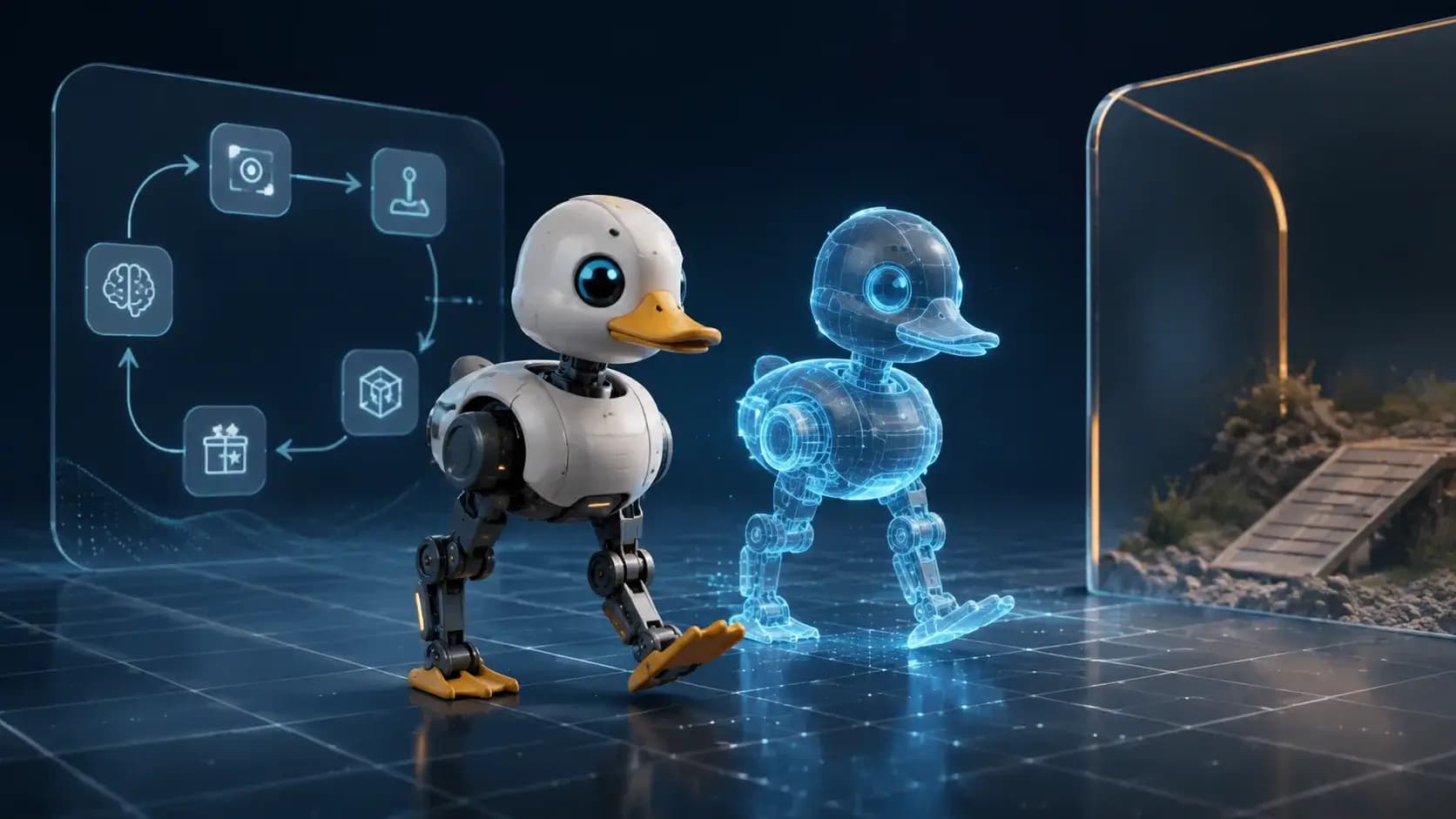
A source-backed overview of Microduck RL environments, the mjlab loop, and sim-to-real safety gates.
microduck_rlMicroduck reinforcement learningmjlab roboticsrobot simulation RL
Start reading →Suggested learning path
01 → 09
01·12 min read·Search intent: Learning
A source-backed overview of Microduck RL environments, the mjlab loop, and sim-to-real safety gates.
microduck_rlMicroduck reinforcement learningmjlab robotics
·13 min read·Search intent: Learning
Start with a pinned mjlab environment, inspect observations and rewards, and save a reproducible rollout.
microduck_rl quickstartMicroduck RL tutorialmjlab environment
·14 min read·Search intent: Learning
Deploy training and evaluation workers with pinned simulators, GPU isolation, artifact storage, and a guarded hardware handoff.
microduck_rl deploymentrobot RL GPU setupsim-to-real deployment
·15 min read·Search intent: Learning
Trace observations through actions, physics, reward shaping, termination, and policy updates in the Microduck loop.
microduck_rl architecturemjlab RL looprobot reward design
·16 min read·Search intent: Learning
Use deterministic fixtures to read environment registration, mjlab adapters, rewards, resets, runners, and checkpoint export.
microduck_rl source coderobot RL implementationmjlab environment internals
·15 min read·Search intent: Learning
Benchmark simulation throughput, GPU memory, parallel environments, checkpoint storage, and accepted-policy review.
microduck_rl performancerobot simulation benchmarkRL training cost
·16 min read·Search intent: Learning
Govern robot assets, checkpoints, telemetry, control interfaces, operator approvals, and incident recovery.
microduck_rl securityrobotics RL safetysim-to-real operations
·15 min read·Search intent: Learning
Choose a robotics RL stack by fidelity, throughput, assets, hardware path, reproducibility, and safety burden.
microduck_rl comparisonrobot simulator selectionmjlab vs real robot
·17 min read·Search intent: Learning
Design a Microduck RL project with task manifests, deterministic fixtures, policy cards, telemetry, and staged hardware gates.
microduck_rl projectsim-to-real labrobot policy card